How Many CCTV Cameras Do You Need? –
One of the first questions homeowners ask when considering CCTV is: how many cameras do I actually need?
It’s a sensible question because many people assume more cameras automatically means better security. In reality, the effectiveness of a CCTV system depends far more on:
- Camera positioning
- Property layout
- Coverage quality
than simply installing large numbers of cameras.
For most homes in Skipton, the ideal setup is usually smaller and more focused than people expect.
There is no “one size fits all” answer
The number of cameras needed depends on:
- Property size
- Access points
- Driveways and gardens
- Detached buildings
- Visibility around the property
A compact terrace and a large detached house will naturally require very different coverage strategies.
What areas should CCTV protect first?
The priority should always be:
- Main entrances
- Rear access points
- Driveways and vehicles
- Side access routes
These are the areas most commonly used during attempted intrusion.
How many cameras does a small house usually need?
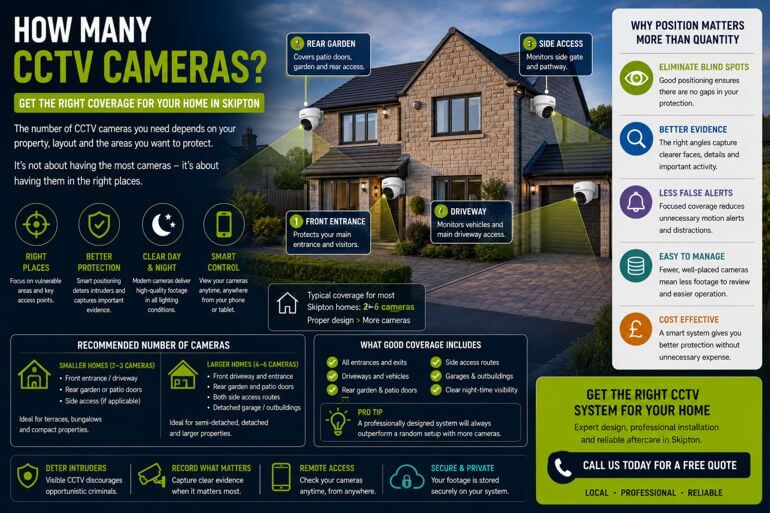
For many smaller homes in Skipton:
- 2–3 cameras is often sufficient
Typical setup:
- Front entrance / driveway
- Rear garden or patio doors
- Side access if applicable
This provides effective perimeter coverage without unnecessary equipment.
What about semi-detached or detached homes?
Larger properties often benefit from:
- 4–6 cameras
This allows coverage of:
- Front driveway
- Main entrance
- Rear garden
- Side access routes
- Detached garages or outbuildings
The goal is eliminating vulnerable blind spots while maintaining good identification quality.
Is more always better?
No.
Too many cameras can actually create problems:
- Unnecessary cost
- Excessive notifications
- More footage to review
- Poorly planned overlap
A professionally designed 4-camera system will usually outperform a badly planned 8-camera installation.
Why positioning matters more than quantity
A single well-positioned camera can often cover:
- Multiple approach routes
- Entrances and pathways
- Vehicle access areas
Incorrectly positioned cameras, however, may:
- Miss faces entirely
- Create blind spots
- Struggle at night
This is why proper system design is critical.
What about rear gardens?
Rear gardens are frequently overlooked but are often one of the most vulnerable areas.
For many Skipton homes, rear coverage is essential because:
- Access is more concealed
- Visibility from neighbours may be limited
- Patio doors are common entry points
Should cameras cover neighbours’ property?
No — systems should focus on protecting your own property appropriately.
Professional CCTV setup helps minimise:
- Unnecessary overspill
- Privacy concerns
- Poorly aimed coverage
Do modern cameras cover wider areas?
Yes.
Modern turret cameras often provide:
- Wide-angle coverage
- High-resolution imaging
- Better low-light performance
This means fewer cameras can sometimes achieve better results than older systems.
Can smart detection reduce the number of cameras needed?
In some cases, yes.
Modern AI-powered systems help cameras focus on:
- Human activity
- Vehicle movement
- Important events only
This improves overall effectiveness without simply increasing camera count.
Final Answer: How many CCTV cameras does a home need?
For most homes in Skipton:
- Smaller properties typically need 2–3 cameras
- Larger homes often benefit from 4–6 cameras
But the most important factor is not quantity — it is:
- Proper positioning
- Good night-time performance
- Correct coverage of vulnerable areas
A smaller, professionally designed CCTV system will almost always provide better protection than simply installing more cameras unnecessarily.